
مقالات
How Forex Leverage Works: A Practical Guide to Margin, Risk and Position Size

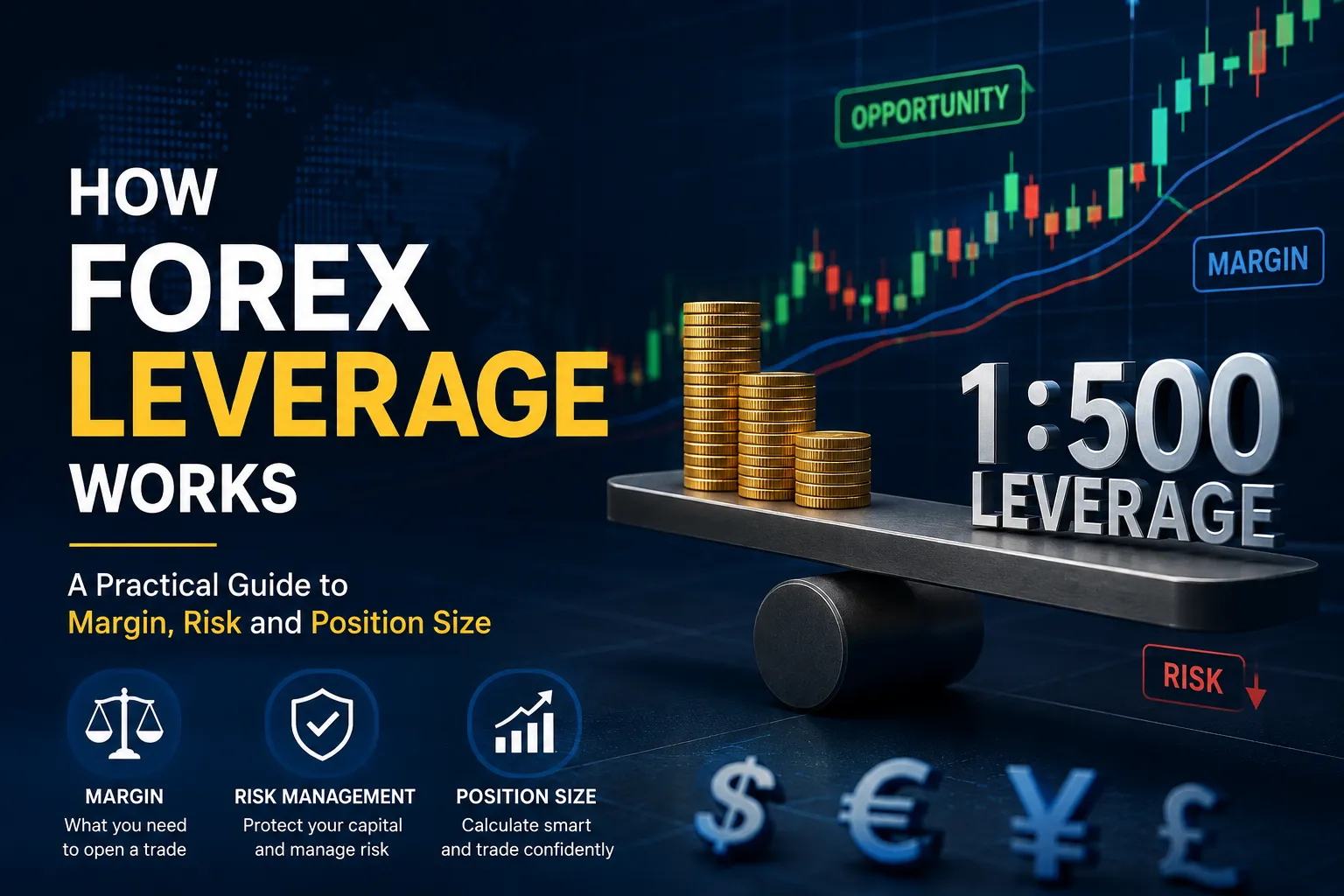
Forex leverage is one of the most important concepts new traders need to understand before entering the currency market. It allows traders to control a larger position with a relatively smaller amount of capital, but it also increases the potential impact of both gains and losses.
Understanding Forex leverage is therefore not simply about finding the highest available ratio. Traders need to understand how leverage affects margin requirements, position size, risk and ultimately the amount of money that can be lost on a trade.
This guide explains how leverage works, how it relates to margin, and how traders can use it more responsibly.
What Is Forex Leverage?
Forex leverage is a mechanism that allows traders to control a position that is larger than the capital deposited in their trading account.
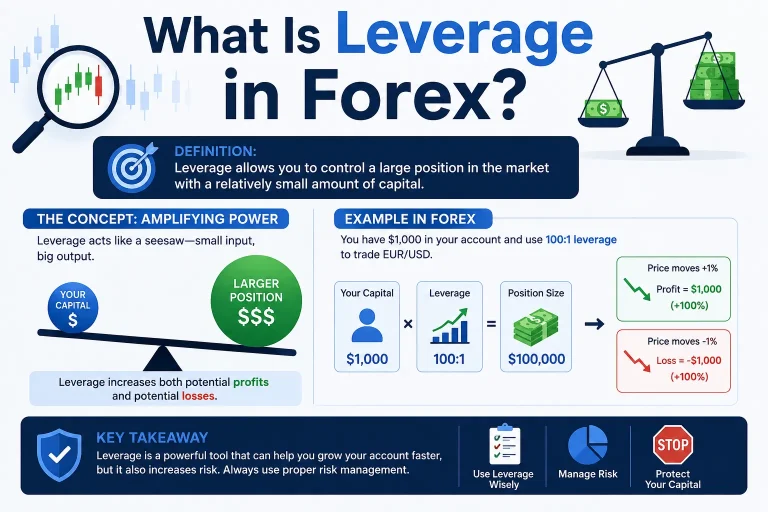
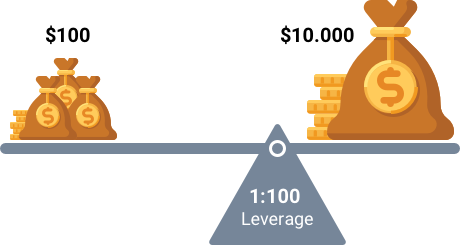
For example, with 1:100 leverage, a trader may control a $100,000 position with $1,000 of required margin.
The important point is that leverage does not reduce the actual market exposure of the position. A $100,000 position remains a $100,000 market exposure regardless of whether the trader deposits $1,000 or $10,000 as margin.
This is why leverage can amplify both potential profits and potential losses.
A small movement in the underlying currency pair can therefore have a significant effect on account equity when the position size is large relative to the account balance.
How Does Forex Leverage Work?
The relationship between leverage and required margin can be illustrated with a simple example.
Suppose a trader wants to open a position worth $50,000.
With 1:100 leverage, the theoretical margin requirement would be:
$50,000 ÷ 100 = $500
With 1:50 leverage:
$50,000 ÷ 50 = $1,000
The higher leverage ratio requires less margin for the same nominal position.
However, this does not mean that the 1:100 position is automatically safer. The actual risk depends primarily on position size, stop-loss distance and market movement.
This distinction is often misunderstood by beginners.
Forex Leverage vs Margin
Leverage and margin are closely connected, but they are not the same thing.
Leverage describes the relationship between the trader’s capital and the size of the position that can be controlled.
Margin is the amount of capital required to open and maintain a leveraged position.
For example:
| Leverage | Approximate Margin Requirement |
|---|---|
| 1:10 | 10% |
| 1:20 | 5% |
| 1:50 | 2% |
| 1:100 | 1% |
| 1:500 | 0.2% |
These figures are simplified examples. Actual margin requirements can vary according to the broker, regulatory entity, asset class, account type and position size.
Some brokers also use dynamic leverage systems. For example, HYCM states that its Forex leverage can be dynamic, with the maximum leverage decreasing as the volume of a client’s position increases.
Why High Leverage Can Be Dangerous
The biggest misconception about Forex leverage is that a higher ratio automatically means a trader should open a larger position.
It does not.
Suppose a trader has a $2,000 account and risks 1% per trade. The maximum planned loss is:
$2,000 × 1% = $20
If the trader uses a 50-pip stop-loss, the position size should be calculated so that a 50-pip movement against the position results in approximately a $20 loss.
The available leverage does not change that predetermined risk.
A trader with 1:500 leverage can still risk only 1% of the account by using an appropriately sized position.
The danger appears when high leverage encourages traders to open positions that are disproportionately large relative to their account.
How Leverage Affects Position Size
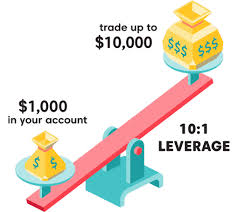
Position sizing should be based on risk rather than the maximum leverage offered by a broker.
A practical process is:
- Determine account equity.
- Choose the maximum percentage to risk.
- Define the stop-loss level.
- Calculate the monetary risk.
- Determine the appropriate position size.
- Check the required margin.
- Enter the trade only if the position meets the risk parameters.
This approach separates available leverage from acceptable risk.
That distinction is particularly important for beginners, because a broker may allow a large position while the trader’s account cannot comfortably withstand the resulting market fluctuations.
Choosing a Forex Broker for Leveraged Trading
When evaluating a broker, leverage should be only one part of the analysis.
Other factors can include:
- Regulatory status
- Available trading instruments
- Margin requirements
- Spreads and commissions
- Trading platforms
- Execution conditions
- Deposit and withdrawal methods
- Customer support
- Account types
- Risk-management tools
For example, traders researching leveraged Forex trading may come across brokers such as HYCM, Orbex and Errante.
Their offerings and applicable conditions can differ by jurisdiction and account type, so traders should review the relevant legal documents and trading conditions rather than comparing leverage ratios alone. HYCM lists Forex, indices, commodities, stocks and other products, while Orbex and Errante also provide access to multiple asset classes and trading platforms.
Does Higher Leverage Mean Higher Profit?
Not directly.
Leverage itself does not determine the profit or loss of a trade. Position size and price movement determine the financial result.
For example, if a trader opens a $10,000 position and the market moves 1% in the trader’s favor, the gross change in the position value would be approximately $100, before trading costs.
If the same trader controls a $100,000 position, the same 1% movement would represent approximately $1,000.
The larger result comes from the larger position—not simply from the leverage ratio.
This is why leverage should be viewed as a tool for controlling capital efficiency rather than as a method for creating guaranteed higher returns.
Forex Leverage and Stop-Loss Orders
A stop-loss is one of the most important risk-management tools for leveraged trading.
Without a predefined exit level, a relatively small adverse market movement can create a substantial loss when the position is oversized.
A sensible trading plan should define the invalidation level before entering the position.
For example:
Entry: 1.1000
Stop-loss: 1.0950
Risk: 50 pips
The trader can then calculate the appropriate position size based on the maximum amount they are willing to lose.
The stop-loss should be connected to the trading idea and market structure rather than chosen simply because it produces a convenient position size.
What Is a Margin Call?
A margin call can occur when a trader’s account equity falls to a level where there is insufficient available margin to maintain open leveraged positions.
Depending on the broker and applicable regulations, positions may eventually be closed automatically if the account reaches the broker’s stop-out threshold.
The exact margin-call and stop-out procedures differ between brokers and regulatory jurisdictions.
This is another reason traders should understand the broker’s trading conditions before using significant leverage.
Common Forex Leverage Mistakes
Using the Maximum Available Leverage
A broker offering 1:500 leverage does not mean a trader should use the maximum available exposure.
Ignoring Position Size
A high leverage ratio can make large positions appear accessible, but affordability and risk are separate issues.
Trading Without a Stop-Loss
Leverage can magnify the effect of unexpected market movements. A predefined risk limit is therefore particularly important.
Risking Too Much on One Trade
Even a well-planned strategy can experience losing trades. Excessive risk per position can make a normal losing streak difficult to recover from.
Focusing Only on Leverage
A broker should not be evaluated solely by its maximum leverage. Regulation, costs, execution, available markets and account conditions can be equally important.
How Much Forex Leverage Should You Use?
There is no universally appropriate leverage ratio for every trader.
A more useful question is:
How large should my position be relative to my account and predefined risk?
A trader who maintains small position sizes may have access to high leverage without using excessive exposure.
Another trader with the same leverage ratio could take substantially more risk by opening much larger positions.
Therefore, responsible leveraged trading is primarily about exposure management, not simply selecting a particular leverage number.
Final Thoughts
Forex leverage can make the currency market more capital-efficient by allowing traders to control larger positions with less margin. However, the same mechanism can magnify losses when position sizes become excessive.
The most important concepts to understand are:
- Leverage determines how much exposure can be controlled relative to available capital.
- Margin is the capital required to maintain a leveraged position.
- Higher leverage does not automatically mean higher profits.
- Position size is more important to risk than the maximum leverage available.
- Stop-losses and predefined risk limits are essential tools.
- Broker conditions can vary by jurisdiction, instrument and account type.
Ultimately, leverage should be treated as a risk-management consideration rather than a shortcut to higher returns. Traders who understand the relationship between leverage, margin, position size and account equity are better equipped to make informed decisions in the Forex market.
Risk Warning: Forex and CFD trading on margin involves a high level of risk and may not be suitable for all investors. Leverage can magnify both profits and losses. Always review the applicable broker terms, regulatory information and risk disclosures before trading.
Source: Broker Decider