
مقالات
How to Choose the Right Food Packaging Machine for an Industrial Production Line

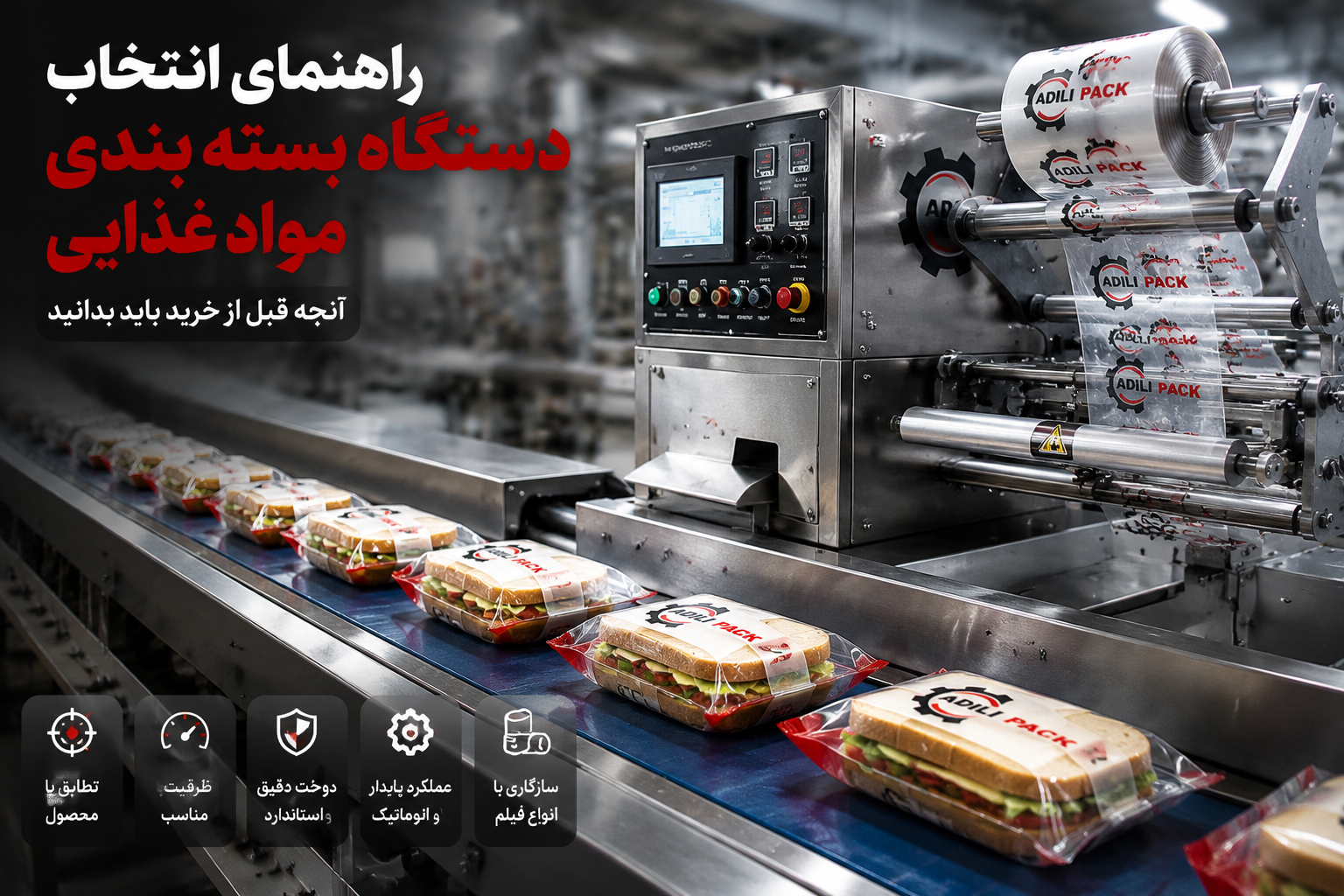
Packaging is one of the most important stages in modern food production. A product may have excellent ingredients and consistent manufacturing quality, but poor packaging can still affect its appearance, handling, distribution and overall customer perception.For industrial manufacturers, packaging is not simply the final step before shipping. It is part of the production process itself.Selecting the right food packaging machine can influence production capacity, packaging consistency, film consumption, labor requirements and the overall efficiency of a production line.However, choosing a packaging machine only by comparing price or maximum advertised speed can lead to costly mistakes.The right machine should be selected according to the actual product, required production capacity, packaging material, factory layout and future production plans.This guide explains the main factors manufacturers should evaluate before investing in food packaging equipment.
Why Is Packaging So Important in Food Manufacturing?
Food packaging performs several functions at the same time.Depending on the product, a properly designed package can help:
- reduce direct contact with the surrounding environment;
- protect the product during handling and transportation;
- create consistent product presentation;
- support product identification and branding;
- simplify storage and distribution;
- increase packaging productivity;
- reduce dependence on manual packaging;
- create a more standardized production process.
For products sold through supermarkets, convenience stores and distribution networks, appearance is also important.Consumers often see the package before they directly evaluate the product itself. Poor sealing, wrinkled film or inconsistent packaging dimensions can negatively affect the perceived quality of the brand.
What Is an Automatic Food Packaging Machine?
An automatic packaging machine performs several packaging operations with limited manual intervention.Depending on the machine configuration, these operations may include:product feeding → film unwinding → film forming → longitudinal sealing → end sealing → cutting → product discharge.Horizontal flow wrapping systems are widely used for products with relatively defined shapes and dimensions.Typical applications may include products such as:
- chocolate bars;
- cakes;
- biscuits;
- confectionery;
- candy products;
- cold sandwiches;
- bakery products;
- snack foods;
- and various individually packaged food items.
However, not every machine configuration is suitable for every product.The machine must be evaluated according to the physical characteristics of the actual food product.
1. Start With the Product, Not the Machine
One of the most common purchasing mistakes is selecting a machine first and then attempting to adapt the product to it.The process should normally begin with the product itself.Manufacturers should identify:
Product length
Product width
Product height
Product weight
Product shape
Product sensitivity
Required package dimensions
For example, a solid chocolate bar behaves very differently from a soft cake during transportation through a packaging machine.Similarly, a cold sandwich may require careful product handling to prevent ingredients from shifting during the packaging process.The product should therefore be the starting point of machine selection.
2. Calculate the Real Production Capacity
Packaging machine speed should always be evaluated in relation to actual factory output.Suppose a production line produces more products per minute than the packaging machine can handle. In that case, the packaging section can become a bottleneck.Products may accumulate before packaging and reduce the efficiency of the entire production line.On the other hand, purchasing equipment with significantly more capacity than required may unnecessarily increase the initial investment. Manufacturers should therefore consider:
- current production capacity;
- target production capacity;
- peak production periods;
- future expansion plans.
3. Evaluate Product Handling
Machine speed is meaningless if products are damaged during transportation.The feeding and conveying system should be suitable for the physical characteristics of the product.This is particularly important for products such as cakes, confectionery and sandwiches.A packaging system should be evaluated for:
- smooth product movement;
- stable positioning;
- appropriate spacing between products;
- minimal unnecessary pressure;
- consistent entry into the packaging section.
4. Pay Close Attention to Sealing Quality
Sealing is one of the most important parts of a packaging process.Poor sealing may cause packages to open during transportation or create an unacceptable visual appearance.When evaluating a packaging machine, manufacturers should check:
- consistency of longitudinal sealing;
- consistency of end seals;
- cutting accuracy;
- film temperature control;
- seal appearance;
- package alignment;
- performance at different operating speeds.
5. Packaging Film Must Match the Machine
Packaging film is another critical variable.Different films have different physical and sealing characteristics.Film thickness, material structure and sealing requirements may affect:
- sealing temperature;
- film tension;
- machine speed;
- cutting performance;
- package appearance.
Whenever possible, machine testing should be performed using the same or similar packaging film that will be used in real production.This provides a much more realistic evaluation of machine performance.
6. Consider Changeover Between Different Products
Many food manufacturers produce more than one product.A bakery, for example, may manufacture several cake sizes. A confectionery company may package different chocolate bars. A food producer may operate several sandwich formats.In these situations, machine flexibility becomes extremely important.Before purchasing, manufacturers should ask:
- Can the package length be changed?
- Can the machine handle different product sizes?
- How long does product changeover take?
- Which mechanical adjustments are required?
- Can the operator perform these adjustments easily?
- Are product settings stored in the control system?
7. Automation and Control Systems Matter
Modern packaging equipment may include digital controls that help operators manage key production parameters.Depending on the configuration, an operator may be able to control:
- conveyor speed;
- package length;
- sealing temperature;
- product positioning;
- film movement;
- production speed.
A well-designed control interface can simplify machine operation and reduce unnecessary operator errors.This becomes especially important in factories operating multiple shifts with different operators.
8. Think About Integration With the Production Line
A packaging machine rarely operates as an isolated piece of equipment.Products normally arrive from an upstream process and move to another stage after packaging.Therefore, machine selection should also consider integration with other equipment.Examples may include:
- feeding conveyors;
- transfer conveyors;
- coding equipment;
- date printers;
- inspection systems;
- counting systems;
- collection conveyors;
- secondary packaging equipment.
Flow Pack Machines for Individual Food Products
Horizontal flow wrapping is commonly used for individually packaged food products with relatively consistent dimensions.In a typical flow wrapping process, the product moves horizontally through the machine while packaging film is formed around it.The film is then sealed and cut to create individual packages.Flow pack systems can be considered for many products, including chocolates, cakes, confectionery and other food items.However, machine configuration should always be selected according to the real product rather than only the general product category.
Chocolate Packaging
Chocolate packaging requires consistent product positioning and good control of the packaging film.Depending on the product format, a packaging machine may be used for:
- chocolate bars;
- individually wrapped chocolates;
- wafer-based chocolate products;
- similar confectionery items.
Cake Packaging
Cakes require particular attention because many cake products are relatively soft.An inappropriate feeding system may deform the product.For this reason, a cake packaging machine should be evaluated for smooth product transfer, correct positioning and stable operation.Testing real cakes before placing an order can help manufacturers evaluate whether the machine handles the product properly.
Confectionery and Rock Candy Packaging
Products such as individually wrapped confectionery or rock candy may have different dimensions and physical characteristics.The machine should be adjusted according to:product length, thickness, required film dimensions and production capacity.Manufacturers producing several product sizes should also evaluate the machine’s adjustment range.
Cold Sandwich Packaging
Cold sandwiches present different packaging challenges compared with dry products.A sandwich may contain several ingredients and can be more sensitive to pressure or incorrect handling.The packaging line should therefore help maintain product shape during transportation.It is also important to remember that packaging equipment does not replace proper food-safety procedures.Products requiring temperature-controlled storage must continue to follow appropriate cold-chain and food-safety requirements after packaging.
What Determines the Price of a Food Packaging Machine?
There is no single price that applies to every industrial packaging project.
Machine cost can depend on several factors, including:
Production Capacity
Higher production requirements may require different mechanical or control configurations.
Machine Configuration
Different packaging formats require different equipment arrangements.
Control System
Automation features and electronic components may affect machine specifications and cost.
Product Dimensions
The machine must be configured according to product and package dimensions.
Additional Equipment
Printers, conveyors and other optional accessories may increase the final project cost.
Customization
Factories with special production requirements may need customized engineering.For this reason, comparing two machines only by their purchase price can be misleading.Technical specifications should be compared at the same time.
The Lowest Purchase Price May Not Mean the Lowest Cost
Industrial equipment should not be evaluated only by the initial purchase price.Manufacturers should also consider the total operating cost over time.
This can include:
- maintenance;
- replacement parts;
- film waste;
- production downtime;
- labor;
- energy consumption;
- changeover time.
A machine with a lower purchase price may become more expensive if it requires frequent downtime or produces excessive packaging waste.Total cost of ownership is therefore an important purchasing consideration.
Why Product Testing Before Purchase Is Important
One of the best ways to reduce purchasing risk is to test the actual product.
A practical test may help evaluate:
- product feeding;
- machine speed;
- film movement;
- sealing quality;
- package dimensions;
- product appearance after packaging;
- operational consistency.
Whenever possible, manufacturers should provide actual product samples and packaging film for testing.The closer the test conditions are to real production, the more useful the results will be.
Maintenance and After-Sales Support
Technical support should be considered part of the machine purchase.Before investing in industrial packaging equipment, manufacturers should ask:
- Is installation included?
- Is operator training available?
- How are replacement parts supplied?
- What maintenance is required?
- What warranty conditions apply?
- How is technical support provided?
Packaging equipment may become a critical point in a production line.If the machine stops, upstream production may also be affected.Reliable technical support and parts availability can therefore have significant operational value.
Choosing a Packaging Machine Manufacturer
Machine specifications are important, but the manufacturer’s ability to understand the production process also matters.A manufacturer should ideally evaluate:
- the actual product;
- package dimensions;
- production capacity;
- film specifications;
- factory layout;
- required optional equipment.
Adili Machinery (Adili Pack) operates in the design and manufacture of packaging machinery for food and similar industrial products. Manufacturers evaluating a packaging project can provide their product dimensions, required capacity and packaging requirements for technical assessment.For companies considering new food packaging machines, comparing equipment based on real production requirements rather than only advertised speed can lead to a more suitable investment.
A Practical Checklist Before Ordering a Packaging Machine
Before finalizing a purchase, manufacturers should verify the following:
- Has the actual product been tested?
- Is machine capacity suitable for the production line?
- Does the product move smoothly through the system?
- Is sealing quality consistent?
- Has the selected film been tested?
- Can the machine handle all required product sizes?
- Is changeover practical?
- Is the machine compatible with the factory layout?
- Are replacement parts available?
- Is operator training provided?
- Are maintenance requirements clear?
- Can additional equipment be integrated later?
A clear answer to these questions can significantly reduce purchasing risk.
Conclusion
Choosing the right food packaging machine requires more than comparing speed and purchase price.Product dimensions, sensitivity, production capacity, packaging film, sealing quality, automation, line integration and technical support should all be evaluated together.The most reliable approach is to start with the actual product and production requirements, then select a machine capable of meeting those requirements consistently. Product testing is also highly valuable before a final purchasing decision. A properly selected packaging system can help manufacturers improve production flow, achieve more consistent packaging and reduce dependence on manual processes.
Frequently Asked Questions
What products can be packed with a flow pack machine?
Depending on machine design and product dimensions, flow wrapping systems can be considered for chocolates, cakes, confectionery, bakery products, sandwiches and various individually packaged food products.
How do I choose the correct packaging machine capacity?
Calculate the actual number of products produced per minute or hour and select equipment capable of supporting the production line without creating a packaging bottleneck.
What affects packaging machine price?
Production capacity, machine configuration, controls, optional equipment, product dimensions and customization can all affect the final cost.
Can one packaging machine handle different products?
In some cases, yes. This depends on the difference in product dimensions and the machine’s adjustment range.